


Quick answer. In Quebec, a vehicle or indivisible load that exceeds the normal limits (notably 4.15 m in height and 2.6 m in width) must travel under a special transport permit issued by the Ministère des Transports et de la Mobilité durable (MTMD). The permit does not guarantee passage: the regulation requires the permit holder to make sure the road network can take its dimensions and loads. The holder must therefore check, along the whole route, bridges, vertical clearances (overpasses, sign structures, wires), widths and turns. By rail, every dimensional shipment goes through a clearance file with the railway. When the margin is thin or the route is long, a 3D route survey with a simulation of the load’s passage finds conflicts before departure instead of at the foot of the overpass.
A transformer leaves the plant on a lowboy trailer. The permit is in order, the escorts are booked, the crane is waiting on site. Halfway there, the convoy stops in front of an overpass: the posted clearance allowed the load through, but the road has been resurfaced since the last measurement, and a few centimetres are missing. The convoy backs up, the site waits, and every lost hour is paid for in escorts, lifting crew and schedule.
This is not an exotic scenario: Topo3D has already had to re-check the clearance under overpasses because the road had been repaved. The special transport permit governs oversize moves, but it leaves the holder responsible for knowing the route. Here is what the regulation requires, what to check on the road and with the railway, and when a 3D route survey beats a height pole.
What is an oversize load in Quebec?
A move is oversize when the vehicle, combination or load exceeds the limits set by the Vehicle Load and Size Limits Regulation (CQLR, c. C-24.2, r. 31.1, in force since January 1, 2026). In general: 4.15 m in height, 2.6 m in width, and a maximum length that depends on the configuration (up to 23 m for several tractor and semi-trailer combinations).
The Highway Safety Code (s. 463) prohibits operating an oversize vehicle without a special permit. The permit is issued only when the excess comes from the vehicle’s construction, added equipment, a road train or an indivisible load: a piece that cannot be dismantled to bring it within the limits. Transformers, vessels, bridge girders, industrial modules, cranes and prefabricated buildings are common examples.
The MTMD special permit classes
The Regulation respecting special permits (CQLR, c. C-24.2, r. 35) divides permits into seven classes.
| Class | What it covers |
|---|---|
| 1 | Oversize: width, height or length beyond the limits, within set maximums (for example 4.30 m in height with a general permit, up to 5 m with a specific permit) |
| 2 | Prefabricated building |
| 3 | Swimming pool |
| 4 | Tow truck |
| 5 | Overweight indivisible load, within the limits of Schedule 1 of the regulation |
| 6 | Exceptional overweight move requiring a Ministère assessment |
| 7 | Exceptional oversize move beyond class 1 limits, requiring a Ministère assessment |
Two forms of permit exist. A general permit is valid for up to one year, with or without a set route (the MTMD states on its website that a general permit with a set route is granted for one month at most). A specific permit covers a set route, round trip included, for up to seven consecutive days.
Applications go through the MTMD’s online permit management system, in service since 2019 (the SAAQ no longer issues these permits). Classes 1 to 5 are generally issued automatically. An application that requires an in-depth review is processed within 15 business days at most, for a complete file. Classes 6 and 7 require a Ministère assessment report confirming the move is feasible; the MTMD offers a free “project mode” request to validate feasibility in advance. Fees are indexed every year: check the MTMD page before budgeting.
The permit also comes with operating rules: signage (amber light, red-and-white striped sign beyond certain dimensions), escorts depending on width and height, permitted hours and days, and no travel in poor visibility or on snow-covered pavement. Some municipalities, including Montreal, also require their own authorization to use their streets.
The permit does not guarantee passage
This is what many shippers discover too late. Section 5 of the regulation requires the holder to verify that the highway system permits the movement of traffic for the dimensions and loads carried. The permit authorizes exceeding the limits; it does not certify that your load fits under every overpass on your route.
The MTMD spelled out this obligation in an Info Camionnage bulletin (March 2021): before an oversize move, the holder checks intersections, ramps and curves, lane widths, vertical clearance under bridges, overpasses, overhead sign structures and utility wires, road work and, for an overweight load, passage over bridges.
The Ministère publishes a directory of bridge vertical clearances, measured on site by its staff. It asks for a minimum margin of 10 cm below those heights and reminds carriers that, for an oversize vehicle, field checks must cover the entire route. The directory does not relieve the carrier of responsibility.
What to check along a road route
Every obstacle has its own logic. A checklist helps.
- Bridges and their capacity. For an overweight load, crossing a bridge depends on its capacity, not just its geometry. The MTMD keeps a directory of bridges with weight restrictions; some permits impose conditions (travel alone, centred, at reduced speed). This structural review belongs to the Ministère and engineers, not to the survey.
- Vertical clearances. Overpasses, footbridges, sign gantries, suspended traffic lights, toll or weigh-station canopies, gas-station roofs. Usable height is not a single number: it varies from lane to lane and from one edge of the deck to the other, and it changes when the road is resurfaced.
- Overhead wires. Power, telecom, cable. A wire’s sag varies with temperature and electrical load: a height measured in January is not the height on a July afternoon. For a class 7 permit above 5 m in height, the regulation requires an agreement with the utilities on moving wires and cables, or a sworn statement that no wire crosses above the route.
- Widths. Guardrails, parapets, poles, curbs, islands, signs, trees, parked vehicles. A wide load does not always hit at ground level: a sign at 2 m is often what blocks it.
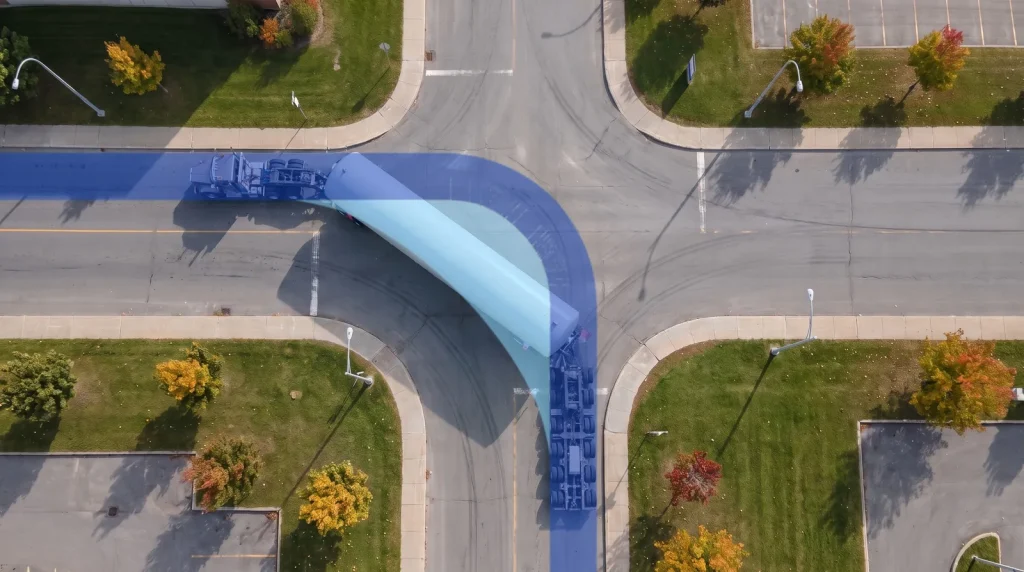
- Turns and intersections. In a curve, a long load sweeps an area much wider than its own width: the front swings out, the middle cuts in. Ramps, roundabouts and plant entrances are the critical spots.
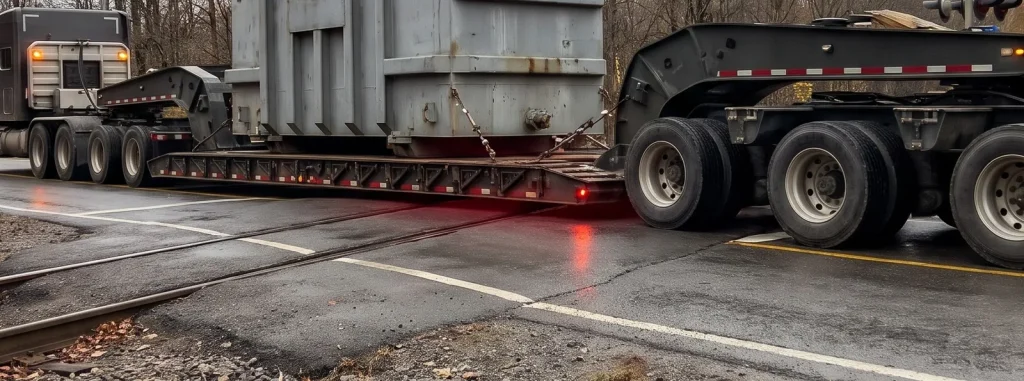
- Grades, cross slopes and crests. A lowboy trailer has little ground clearance. A humped rail crossing, a dock entrance or a change in grade can catch it in the middle, even when height and width clear. Topo3D surveys these vertical curves precisely for long lowboy trailers. A steep cross slope tilts the load and reduces the margin under a side obstacle.
- Road work. A narrowed lane or temporary detour can change the route between planning and departure.
Overpasses and tunnels: when vertical clearance changes
The Louis-Hippolyte-La Fontaine bridge-tunnel in Montreal is a very current example. Its rehabilitation cost it 10 cm of vertical clearance, from 4.4 m to 4.3 m, and the MTMD states that a vehicle must be no taller than 4.2 m to travel through it safely. In the months after the first rebuilt tube reopened in May 2025, the Ministère logged about ten incidents involving over-height vehicles northbound, mostly lane-control lights struck and cables torn off. In October 2025, a float carrying an excavator struck the ceiling at the southbound entrance and forced the closure of Highway 25 toward the South Shore. Despite a physical height gauge at the south entrance and a detection system northbound, the tunnel still had to be closed overnight in early November 2026 to repair damage caused by over-height trucks.
These incidents mostly involve ordinary trucks, not permitted convoys. But the lesson applies twice over to an oversize move:
- Vertical clearance is not permanent. Rehabilitation, resurfacing or added equipment (lane-control lights, cables, signs, lighting) reduces it. A measurement or directory a few years old may no longer hold on moving day.
- The low point is not always at the centre of the lane. In a tunnel, the vault, lighting, ventilation and suspended signs make usable height vary from one edge of the lane to the other. Under an overpass, the deck may slope and the road may have cross slope.
- The margin matters as much as the height. At the bridge-tunnel, the gap between posted and safe height is 10 cm, which is the minimum margin the Ministère asks for below the heights in its directory.
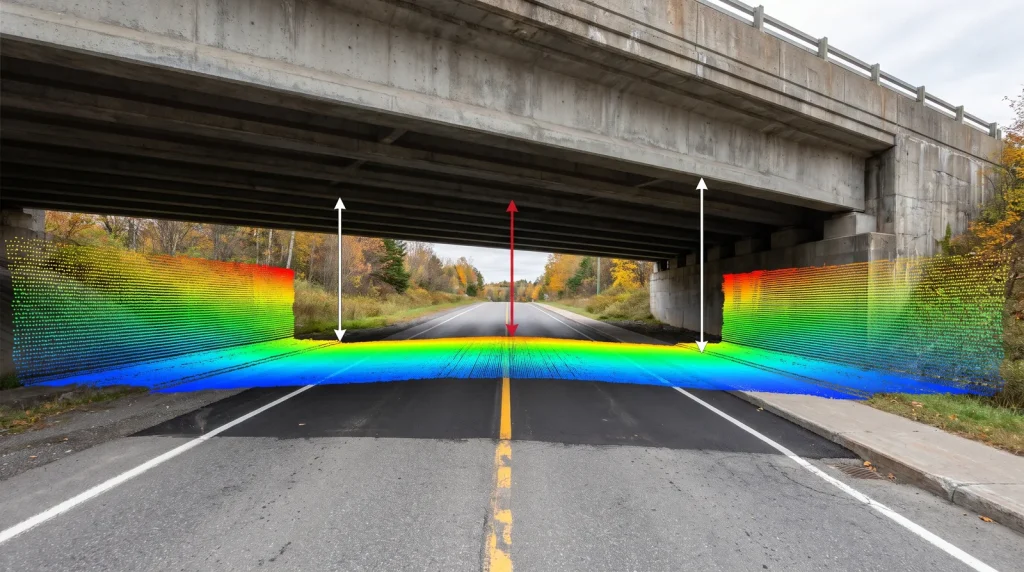
For a tight structure, the 3D survey measures the full section at each portal and along the whole length, with all suspended equipment, then compares each section with the load profile. It is the method used in the Port-Daniel rail tunnel (see below), and it applies just as well to a road tunnel or an overpass. Topo3D also knows the bridge-tunnel well: our crews surveyed the tunnel and its approaches several times between 2018 and 2024 for its design and rehabilitation.
By rail: the clearance file with CN and CPKC
On the rail network, the logic is the same, but the process is centralized: each railway reviews out-of-gauge shipments on its own network. In Quebec, the two main networks are CN and CPKC (formerly Canadian Pacific, which became Canadian Pacific Kansas City in 2023). At CN, a shipment is dimensional if it meets one of the conditions published by the railway: for example a height of more than 15 ft 6 in above the rail when loaded, a width from 10 ft 8 in or wider than the reference loading envelope (AAR “Plate C”), a high combined centre of gravity, or a weight beyond track capacity on a standard car.
Every dimensional shipment requires a clearance file. The shipper or its agent fills out CN’s request: overall dimensions of the load on the car, projections included, vertical centre of gravity, weight, car type, origin and destination, and if needed a table of widths at various heights. A detailed shipping drawing is required for the widest loads. CN’s clearance bureau reviews the route, sets the shipment’s class (regular train, dimensional train or special train depending on width) and gives its consent. CN also requires an inspection of the loaded car before departure.
CN says to allow three to eight weeks to open an account, obtain the clearance report and supply a car: planning starts early. At CPKC, the railway’s general tariff requires customers to obtain the required permits and CPKC pre-authorization for any shipment that exceeds standard equipment dimensions. When a route crosses from one network to another, the final routing depends on clearance approval; according to the Railway Association of Canada, the shipper and the originating railway must verify clearance over the entire route.
The weak spot in that file is often the load itself. Dimensions come from the manufacturer’s drawing, while the railway reviews the load as it sits on the car, with its cradles, tie-downs and projections. A profile measured on the loaded piece removes that uncertainty. And when the route includes a tight structure (tunnel, covered bridge, dock, plant spur), measured sections of that structure complete the file.

By water: docks, ramps and barges
The largest pieces often arrive by barge. The critical passage then moves to the dock: water depth on approach, condition and slope of the ramp, dock capacity, the path of the crane or modular transporter between barge and road. A bathymetric survey of the berth merged with the dock survey gives one continuous surface, from shore to bottom, to plan the unloading.
Spot measurement or 3D route survey?
For a small excess on a known route, a height-pole check and a road reconnaissance may be enough. A 3D survey takes over when the margin is thin, the route is long or a mistake would be costly.

| Criterion | Spot measurement (pole, tape) | 3D route survey with simulation |
|---|---|---|
| What you get | The lowest point or the width at one spot | The full section: height, width, guardrails, poles, grades, cross slopes |
| Turns | Estimate | Load sweep simulated in the real geometry |
| Overhead wires | A height at a given moment | A height at a given moment, located and documented in the report |
| Crew safety | Repeated stops on the roadway | Mobile LiDAR in traffic; static scanning only at pinch points |
| Reuse | None: another load needs another reconnaissance | Another load is simulated in the same cloud, without returning to the field |
| Evidence | Notes and photos | List of conflicts, dimensioned sections, georeferenced cloud |
The logic fits in one analogy: the height pole is asking someone whether your sofa will fit through the door; the 3D survey is measuring the whole stairwell, then turning the sofa inside it before you lift it.
When a 3D survey with simulation saves a stop
A 3D survey earns its cost when one of these applies:
- The margin is thin. A few centimetres under an overpass or between two guardrails, where a spot measurement does not tell you whether the side of the load clears too.
- The route is long or new. A mobile mapping survey captures tens of kilometres in traffic, without closures; the load is then simulated along its full length.
- The load has an irregular shape. A vessel with projections, a transformer with its bushings or a dismantled crane is not a box. The simulation uses the piece scanned on its carrier, not its rectangular envelope.
- The move changes modes. Road, rail and dock in one model: the load is checked from plant to site.
- The load will come back. A manufacturer that ships regularly along the same corridor reuses the survey for every new piece.
- Post-move condition matters. A before-and-after survey documents the pavement, useful when a site owner or municipality worries about damage.
For tight spots (tunnel, pipe rack, plant door), mobile LiDAR is complemented by static laser scanning, denser, section by section. And like any measurement, it has its uncertainty: the margin you keep must account for it, as we explain in the true accuracy of a point cloud.
In the field: what Topo3D has already simulated
- Rail, tunnel. In 2018, Topo3D scanned the Port-Daniel–Gascons rail tunnel in Gaspésie for Hatch, then simulated the passage of 42 m and 44 m wind turbine blades by comparing each tunnel section with the railway and blade envelopes (the project).
- Rail, load on car. In 2021, at the ABB plant in Varennes, Topo3D scanned transformers loaded on railcars and drew their transport profile in DWG, enabling CN to validate their passage on its tracks (the project).
- Rail, port to plant. In 2024, Topo3D scanned rail lines between the Port of Hamilton and a plant, then simulated the passage of oversize equipment to identify potential conflict points (the project).
- On-site move. In 2018, at the Port of Montreal, Topo3D scanned the route of a gantry crane for Aciers Richelieu to simulate its move (the critical point: the height of the light poles, which the crane had to clear without hitting them), then verified that the pavement had not been damaged (the project).
- Dock and barge. In 2024 and 2025, Topo3D carried out the bathymetry, 3D scanning and surveying for a temporary floating dock in Varennes for McKeil Marine, to unload oversized equipment (the project).
How a clearance study works
- The load. We scan the piece on its trailer or railcar, or start from the manufacturer’s 3D model if it is not built yet, then confirm on the real piece before departure.
- The route. Mobile LiDAR on the road or track, static scanning at pinch points, bathymetry at docks and ramps.
- The simulation. The load’s volume moves through the point cloud; every spot where it hits or nearly touches an obstacle is logged.
- The report. Located list of conflicts, with photo and section; load profile; georeferenced cloud and drawings in open formats. A technical lead checks the report before it is sent.
- Moving day. On request, on site during the move and a survey afterwards to document pavement condition.
The survey supports planning; it does not replace the permit, the Ministère’s structural assessment, the railway’s consent or the utility’s confirmation of wire heights.
Five questions to ask before ordering a route survey
- Will the load be measured as loaded, on its carrier, or only from the manufacturer’s drawing?
- Does the survey cover the whole route, from the plant yard to the site, including entrances, docks and level crossings?
- Does the simulation account for turns and grades, or only heights and widths in a straight line?
- How are overhead wires handled, and does the report clearly say it is a height at the time of the survey?
- Which files will you receive, in which formats, and can you simulate another load in them later?
To learn more about our dimensional load clearance survey by road, rail or barge, see the service page.
Conclusion
The special transport permit settles the legal question; it leaves the holder with the question of passage. Bridges, vertical clearances, wires, widths, turns and grades: the whole route must be checked, and with the railway, the load must be described as it sits on its car. When the margin is thin, the route is long or the load is complex, a 3D route survey and a passage simulation move the discovery of conflicts from moving day to the office, where it costs the least.
FAQ
- Who issues special transport permits in Quebec?
The Ministère des Transports et de la Mobilité durable, through its online permit management system. Classes 1 to 5 are generally issued automatically; classes 6 and 7 require a Ministère assessment report confirming the move is feasible. - Does a special permit guarantee my load will clear the route?
No. The regulation requires the holder to make sure the road network can take its dimensions and loads. The holder must check bridges, vertical clearances, wires, widths, turns and road work along the entire route. - Is the MTMD vertical clearance directory enough?
It is a good starting point, but the Ministère asks for a margin below the published heights and for field checks along the entire route of an oversize vehicle. It also does not cover wires, private sign structures or site entrances. - Is a route survey required to obtain a permit?
The regulation does not prescribe a method. It prescribes a result: the load must clear. For a tall class 7 load, it also requires an agreement with the utilities on wires, or a sworn statement that no wire crosses above the route. A 3D survey documents these checks. - How does clearance work with CN or CPKC for an oversize rail load?
The shipper or its agent files a clearance request with the overall dimensions of the load on its car, its centre of gravity, its weight and the car type. At CN, the clearance bureau reviews the route, sets the shipment’s class and gives its consent. At CPKC, railway pre-authorization is required for any shipment that exceeds standard dimensions. Allow several weeks. - What is the vertical clearance of the Louis-H.-La Fontaine tunnel?
Since its rehabilitation, the posted vertical clearance is 4.3 m (4.4 m before), and the MTMD says a vehicle must be no taller than 4.2 m to travel through it safely. Heights can change during work: check network conditions on Québec 511 before every departure.
Planning an oversize move by road, rail or barge? Tell us about your load and route: we will recommend the right survey and send you a quote within 24 to 48 hours.
References
- Government of Quebec (2026). Regulation respecting special permits, CQLR, c. C-24.2, r. 35 (up to date as of July 1, 2026). https://www.legisquebec.gouv.qc.ca/fr/document/rc/C-24.2,%20r.%2035?langCont=en
- Government of Quebec (2026). Vehicle Load and Size Limits Regulation, CQLR, c. C-24.2, r. 31.1. https://www.legisquebec.gouv.qc.ca/fr/document/rc/C-24.2,%20r.%2031.1?langCont=en
- Government of Quebec (2026). Highway Safety Code, CQLR, c. C-24.2, s. 463. https://www.legisquebec.gouv.qc.ca/en/document/cs/C-24.2
- Ministère des Transports et de la Mobilité durable. Permis spéciaux de circulation : classes 1 à 7 (French). https://www.transports.gouv.qc.ca/fr/entreprises-partenaires/ent-camionnage/permis-speciaux/Pages/classes-1-a-7.aspx
- Ministère des Transports et de la Mobilité durable. Demander et gérer un permis spécial (French). https://www.transports.gouv.qc.ca/fr/entreprises-partenaires/ent-camionnage/permis-speciaux/Pages/demander-gerer-permis-special.aspx
- Ministère des Transports (2021). Info Camionnage: checks before an oversize move (March 25, 2021, French). https://www.transports.gouv.qc.ca/fr/entreprises-partenaires/ent-camionnage/Documents/info-camionnage/IC25032021%20-%20V%c3%a9rifications%20avant%20THN.pdf
- Ministère des Transports et de la Mobilité durable. Hauteurs libres des ponts au Québec (French). https://www.transports.gouv.qc.ca/fr/entreprises-partenaires/ent-camionnage/hauteurs-libres/Pages/hauteurs-libres-ponts-quebec.aspx
- CN. Dimensional loads. https://www.cn.ca/en/your-industry/dimensional-loads/
- CN. What is a dimensional shipment? https://cn.ca/-/media/files/customer-centre/customer-centre-documents/what-is-a-dimensional-shipment-en.pdf
- CN. Dimensional classification. https://www.cn.ca/-/media/files/customer-centre/customer-centre-documents/dimensional-classification-en.pdf
- CPKC (2026). Tariff CPKC 1, Item 11400: Safe Shipping Requirements. https://www.cpkcr.com/content/dam/cpkc/customer-resources/pricing-and-tariffs/2026-updates/CPKC%201%202026.1%20Pub%202026.04.01%20Eff%202026.05.01_FINAL.pdf
- Railway Association of Canada (2023). Dimensional restrictions. https://www.railcan.ca/wp-content/uploads/2023/04/6-DIMENTIONAL-RESTRICTIONS.pdf
- La Presse (2025). Un poids lourd accroche le plafond et force la fermeture de l’A25 sud (October 14, 2025, French). https://www.lapresse.ca/actualites/circulation/2025-10-14/pont-tunnel-louis-h-la-fontaine/un-poids-lourd-accroche-le-plafond-et-force-la-fermeture-de-l-a25-sud.php
- Transport Routier (2025). Système de détection des camions trop hauts pour éviter les incidents au tunnel La Fontaine (August 8, 2025, French). https://www.transportroutier.ca/nouvelles/systeme-de-detection-des-camions-trop-hauts-pour-eviter-les-incidents-au-tunnel-la-fontaine/
- Transport Routier (2026). Dommages causés par des camions trop hauts : le tunnel La Fontaine fermé de nuit ce week-end (November 4, 2026, French). https://www.transportroutier.ca/nouvelles/dommages-causes-par-des-camions-trop-hauts-le-tunnel-la-fontaine-ferme-de-nuit-ce-week-end/